
The Bakerdex — Entry 02: Using the Glaze Matrix to Make Any Glaze
A visual system for understanding how glaze thickness and fat level affect texture, finish, and flow.

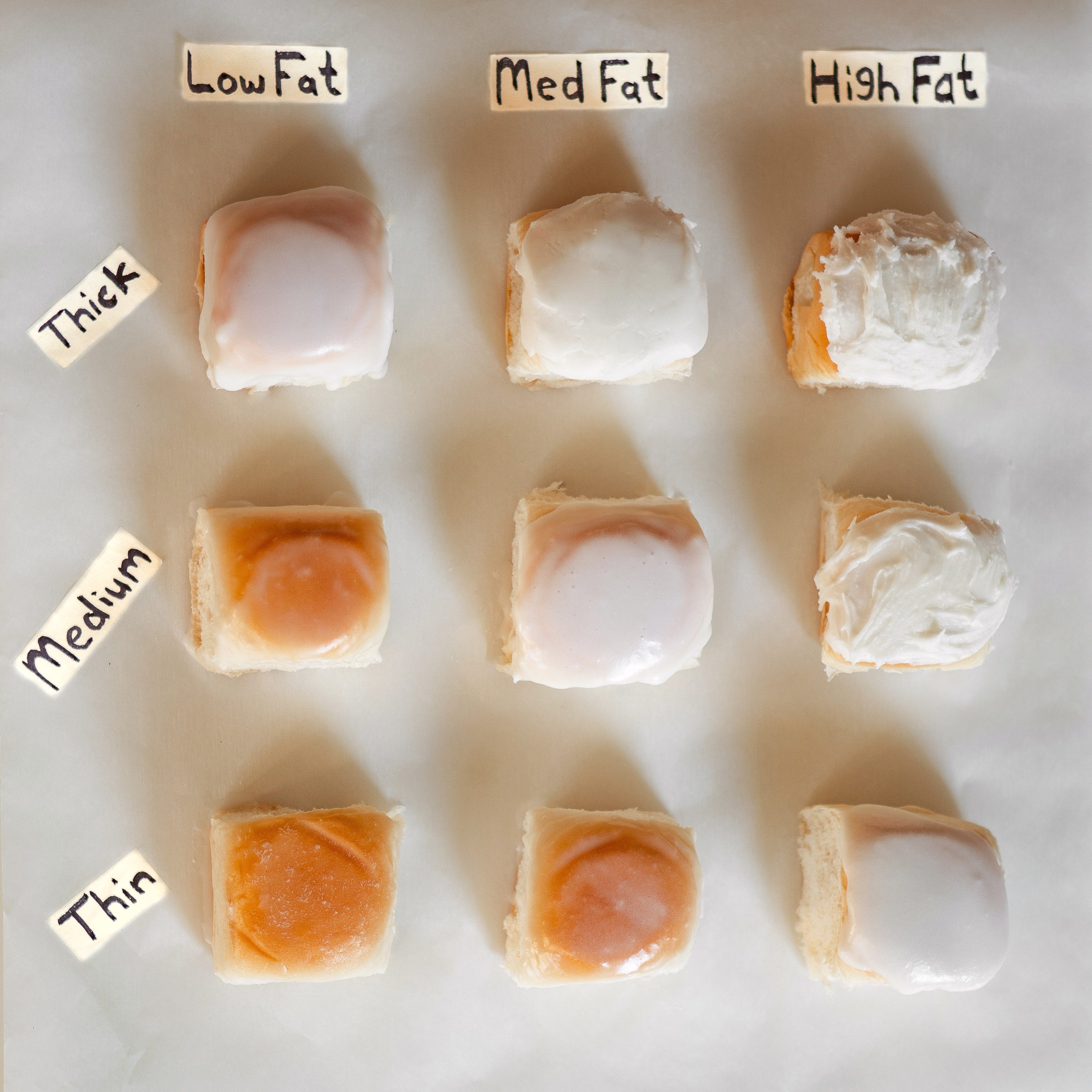
This post builds on The Bakerdex — Entry 01, which introduces the fat–liquid framework behind the Glaze Matrix.
The Bakerdex is an ongoing index of baking frameworks, comparisons, and concepts. Each entry stands on its own, but together they form a growing reference for how we can think about baking. Discussion is encouraged :)
When it comes to baking, one of the easiest things to rush is the finishing glaze. Especially after all the work you’ve already put in.
I’ve definitely been there. By the time I reach the final stretch of a bake, glazing can start to feel like something to get through rather than think about.
Not because glazes are simple, but because most glaze recipes are. A recipe can only take you so far, but it can’t adapt in real time.
That’s why I decided to create The Glaze Matrix.
Almost every glaze you’ve ever made comes down to two choices:
How much liquid you add
What kind of liquid (fat level) you use
The Glaze Matrix organizes those two variables so you can build or fix a glaze without guessing.
A Note on Variables (and Why I Chose These Two)
Yes, there are other variables that affect glaze behavior.
Things like:
Temperature
How warm the pastry is
How long the glaze sits
Humidity
All these matter.
But liquid amount and fat level are the variables most responsible for the final outcome: how a glaze flows, sets, feels, and looks once applied.
That’s why the matrix focuses on these two first.
If you control them, most glaze problems disappear.
The Two Variables That Control Glaze
1. Liquid Amount (Thickness)
Liquid amount controls how a glaze behaves:
Less liquid → thick, firm, minimal drip
Medium liquid → controlled drip
More liquid → thin, fluid, brushable
In the matrix, this is the vertical axis:
Thick
Medium
Thin
2. Fat Level (Mouthfeel + Finish)
Fat level controls how a glaze sets and feels:
Low fat (water or milk) → classic sugar glaze, clean set
Medium fat (butter + milk) → soft, rich, bakery-style
High fat (cream + corn syrup) → glossy, elastic, professional finish
This is the horizontal axis of the matrix.
A Quick Clarification on “High Fat” Glazes
Butter is technically higher in fat by percentage.
However, glazes made with cream and corn syrup behave richer because:
The fat remains fluid at room temperature
Sugar crystallizes more slowly
The glaze stays elastic and glossy instead of crusting quickly
That’s why cream + corn syrup earns the “high fat” category in the matrix. It’s based on behavior, not pure nutrition labels.
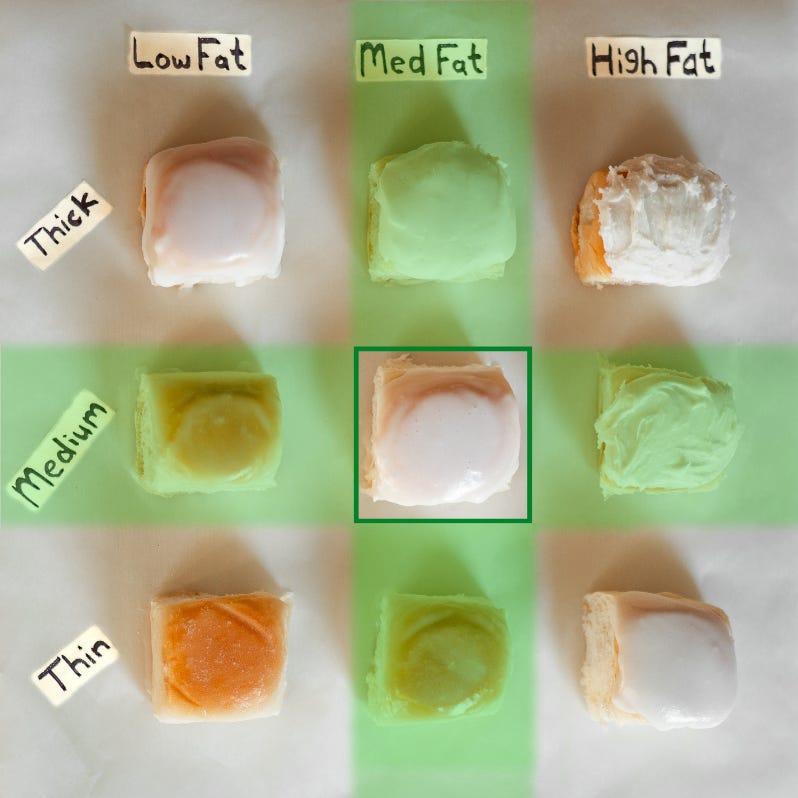
How the Matrix Works
Once you choose:
A thickness
A fat level
You simply look at where those two intersect.
That intersection tells you:
How much liquid you need
What kind of liquid to use
How the glaze will behave once applied
You don’t need to memorize a recipe for this, just the logic. Everything else falls into place.
About the Ratios
All ratios in The Glaze Matrix are expressed as a percentage of powdered sugar.
Powdered sugar is always the reference point.
Everything else scales from there.
This means you can:
Make a small batch or a large batch
Fix a glaze that’s too thick or too thin (I’ve been there 100 times haha)
Adjust richness without changing flow
Once you understand the percentages, the matrix becomes very intuitive and quick to use!
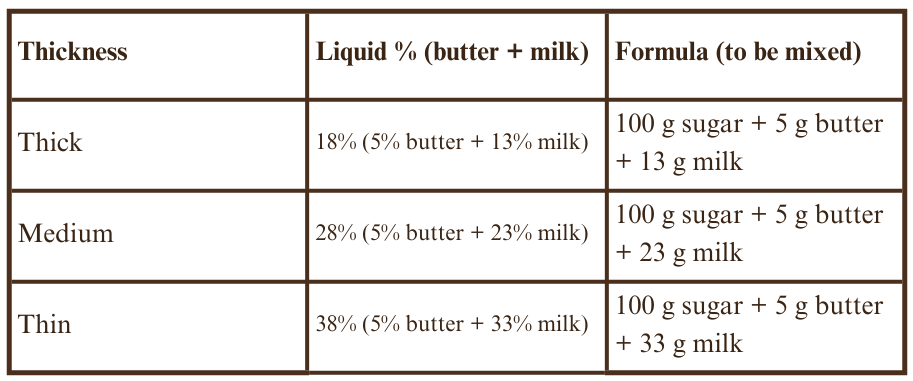
A Quick Example
Let’s say you want a medium-fat, medium-thickness glaze (the kind you’d use on cinnamon rolls).
Choose your sugar amount (for example, 100 g)
Medium thickness calls for 28% total liquid
Medium fat uses butter + milk
Butter = 5% of sugar
Milk = the remaining liquid
This same method is applied to every glaze you see in the matrix.
Why This Matters
Instead of asking:
“Which glaze recipe should I use?”
You can ask:
“How thick do I want it, how should it set, and how rich should it feel?”
Changing our mindset on this removes most of the guesswork from glazing.


The Guide
I put all of this into a visual guide that shows:
The full matrix
Each glaze class
Ratios, behavior, and best uses
It’s designed to be something you can reference while baking, not just read once.
If glazing has ever felt inconsistent or unpredictable (which it has for me many times), this system is meant to make it consistent and repeatable.
I hope this guide serves you well on your glazing journey! Thanks so much for reading and take care!
This guide is part of a larger body of work I’m building around repeatable baking systems.
The Bakerdex is an ongoing index of baking frameworks and applied guides. New entries are added periodically.
Related Bakerdex Entries:
The Bakerdex — Entry 01: The Glaze Matrix
The Breakfast Nook is a reader-supported publication. To receive new recipes, helpful guides, and to support my work, consider becoming a free subscriber!
Wow, this is incredibly well thought out and helpful!! Thank you so much for all the time and testing you put into this and for sharing with us! I love a glaze/frosting but always dreaded making them because I usually was winging it and hoping for the best. Consistent results backed by a plan is just what I needed 🥰
This is awesome, Miles! Thanks for making it!!